We seem to be inherently double-minded. I find with all kinds of things that part of me thinks one way and is ready for action, but another part of me doesn’t cooperate. This could be characterized as a disagreement between higher and lower brains. My higher self knows the best action, but my lower self keeps hindering, sometimes directing the opposite way!
The apostle Paul admits this about himself in Romans 7:
We know that the law is spiritual; but I am unspiritual, sold as a slave to sin. I do not understand what I do. For what I want to do I do not do, but what I hate I do.
For I have the desire to do what is good, but I cannot carry it out. For I do not do the good I want to do, but the evil I do not want to do—this I keep on doing.
But the dilemma isn’t just regarding sinful behavior. The same mechanism applies to desired actions that have ordinary earthly value. My lower brain replies to the higher: Oh, that’s great—you figured out a good thing to do, but you’re not the one who has to do it! Your poor body has to work to accomplish what you think is so great!
Some of us accomplish more because we have discipline. Obtaining discipline seems a mysterious feat. Yet, many of us also sometimes grow up without much notice of our higher brains at all. We are overly dominated by the lower one.
America was founded during a time when advanced societies grappled with this dilemma, concerning what was called the “peculiar institution.” Slavery, it had been noticed, was cruel treatment of human beings that depended on those in power somehow convincing themselves that it was ok. They reasoned that slaves weren’t people—but livestock. Or if they admitted they were people, the slave was a lower form, meant to be used like a beast of burden.
In that time, Thomas Jefferson wrote the most important words since the ancient scriptures:
We hold these truths to be self-evident, that all men are created equal, that they are endowed by their Creator with certain unalienable rights, that among these are Life, Liberty, and the pursuit of Happiness.
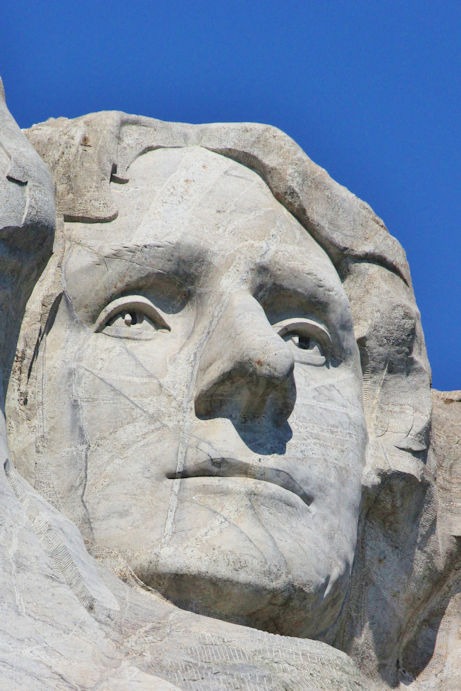
Jefferson at Mount Rushmore. Credit: Tinasuzanne, via Wikimedia Commons
We now know that “men” should be interpreted “humans,” which includes women, children, and people of all races, ancestry, religious belief, and country of origin.
Jefferson probably had an inkling that when he wrote “men,” it would become, in one way or another, controversial. Either it should apply to all humans, or else we must establish what qualifies a person to be a man. Male genitalia? A certain level of intelligence? Proper morals? Pale skin hue? Owning land? Having a big enough bank account?
We know that Jefferson lived his entire life in contradiction to his vitally important declarative statement. He not only always owned slaves and never freed them, but he had children with one of them and treated these progeny also as slaves. Before the end of his life, he must have known that America would have to go through hell for the contradiction left unsolved by the founders.
Decades later, Mark Twain would observe that people calling themselves Christians would still seem to be oblivious to the issue. Ron Chernow, in his recent biography of Twain, says that having grown up in a slave-owning community, yet knowing enslaved people personally, the adult Twain liked to cast ridicule on hypocritical leaders and powerful elites.
One thing in retrospect that weakened Mark Twain’s faith in the church of his childhood was its unswerving endorsement of slavery. The evidence of slavery’s misery stood scattered all around him. The saddest faces Sam Clemens ever saw were those of a dozen shackled slaves on Hannibal’s dock awaiting shipment farther south, but he heard no condemnation from religious leaders. Nearly half the families in Marion County held at least one person in bondage, almost invariably with a clear conscience.
“In my schoolboy days,” Twain said, “I had no aversion to slavery. The local pulpit taught us that God approved it, that it was a holy thing, and that the doubter need only look in the Bible if he wished to settle his mind.”
Beyond preaching slavery, pastors practiced it unashamedly. Twain remembered one Methodist minister who sold an enslaved child to a fellow minister, who then profited by later selling the child downriver. As the steamboat departed with her offspring, the child’s mother wept inconsolably at the dock.
As he got older and developed into an avid student of history, Twain came to believe that the church had endorsed slavery for centuries, and reformed its position only after congregants turned against it. Church complicity in slavery came to illustrate for him how social institutions could collude in a lie of silent assertion that nothing is going on, which fair and intelligent men are aware of, and are engaged by their duty to try to stop.
Perhaps the higher mind of even religious people can be so dominated by the lower that a contradiction never occurs to them. Christianity calls us to pay attention to the “better angels of our nature,” as Lincoln put it. Twain was disgusted enough with the failure of religious people to rise above hypocrisy that he chucked the whole thing.
I’ve suggested atheism is the wrong response, like throwing the baby out with the bathwater. The teaching of Jesus is not proved inadequate when people who say they believe in him fail to obey.
Twain will, of course, have failed to notice his own inability to act the way his higher self knew was best. That is part of being human.
In community, we can try to help each other do better. Partly, this helps us stay humble and not think we are such paragons of perfection. Also, we can see that no one is immune from the problem, as Paul said. We can try to improve by adopting a few strategies. Not pretending or deceiving others (or ourselves) should be high on the list. A second tip is freedom from the need to be respected or to stand out in some positive aspect. Being comfortable with uncertainty is also an excellent habit.
I think Jesus provides the best way. I advocate for him, yet I do not claim that those who don’t appreciate him are lost. It remains possible that he knows their hearts and sees the guidance they follow. Some guidance might lead them astray; other guidance the same way as Jesus. He can be followed without being fully known. Walking the path with others, each with their own take on best practices, cannot but help.
Indeed, more than two thousand years ago, we received his excellent guidance on how to live well and get along with other humans. Some commands are extremely difficult to follow, such as always putting others before ourselves and forgiving those who have hurt us and don’t care what we think about them. But even the easier commands, while finding assent in our higher brain, seem to annoy our lower one. Giving and receiving love may be the best antidote.
The great progress humanity has made in scientific understanding of nature has not been accompanied by much spiritual progress. Every generation has to start from scratch. We get tips (good or bad) from parents or peers. However, nobody but us can get our lower self to pay attention to our higher one. It takes faith—that is, trust. Having faith in Jesus means trusting that he knew what he was talking about. Having faith means trusting that the Creator made this a life-affirming universe, and we are best off when we get with the flow.
1 thought on “A Particularly Human Dilemma”