Alone is not how we begin life. Hopefully, our mothers felt deep joy as they held us to their breasts and shared life-giving milk, while marvelling fathers nearby embraced both with strong protective arms.
Families naturally provide the necessary environment for each of us to join the wider human family. As a species, we thrive in community. Yet, we are all autonomous. We must discover our own uniqueness and differentiate ourselves from loved ones who nurtured and taught us. We must discover that we have everything within ourselves—full capacity to make our own way.
We do not often enough find ourselves alone. But maybe solitude gives us a healthy and rare chance to reflect on those vital existential questions:
Who am I?
Why am I here?
Where do I come from? and,
Where am I going?
Some of us in solitude sense a connectedness to everything. We may be alone, but we are made of the same stuff as Mother Earth. We breathe air. That air has been made by earthly processes and infused with moisture, pollen, yeasts, dust, and all kinds of stuff. We not only breathe it, but our bodies are saturated as we live in it. Some air we breathe has been exhaled by nearby animals. Solitude from humanity may awaken our senses to other connections. Walking the solid earth beneath our feet, we might get a glimpse of Eden. The trees, growing things around us, with tiny insects buzzing in and through them—then fleeting glimpses of larger animals: a coyote or bear, a squirrel or a rabbit. We can identify with their daily scurrying. They just want to live.
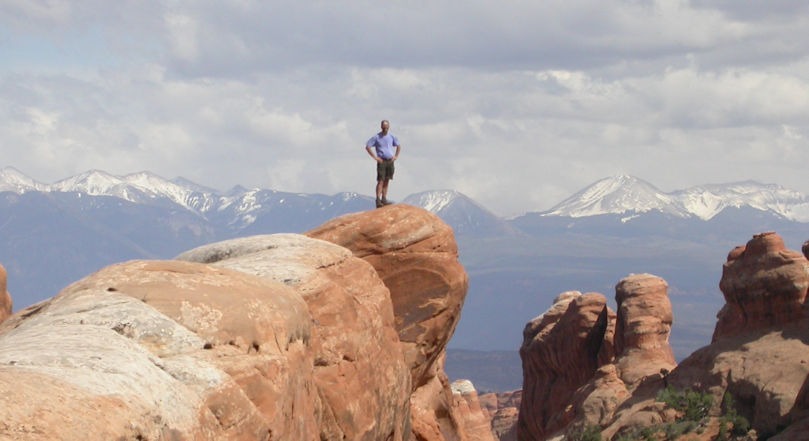
Or we can take a longer view. Scan the horizon. Sense distance. Earth may be tiny compared with the solar system, but we are mere specks in its landscape.
The ultimate existential question may enter our minds. Where did all of this come from? We have learned that Earth is but an iota of life in an enormous black, mostly empty space. Other planets and stars, incredibly far away, yet much bigger than our little home, cannot foster life. They are barren. Yet, they exist. At night, in solitude in a dark sky location, we may experience vertigo, looking up at the vast array of white pinpoints, swathed in an arc above us.
By yourself, you may realize that no one can tell you what or how to believe. No matter that someone else has suggestions—you are free to decide what you think and feel. Some may not have the mental or spiritual capacity even to consider such questions. That’s ok. They may laugh or scoff at us, we who waste our time thinking such things. But they are not entitled to restrict us.
A basic source of religious feeling is the idea that some beliefs and behaviors align with reality and some don’t, and that reality is more than the merely physical. The life-affirmation advocated by many religions is not something scientists can test. Too many variables suggest too many unbounded hypotheses.
With science, your thoughts and actions either align with physical reality or they don’t. But science cannot see beyond the natural, physical realm. Religion suggests the possibility of a supernatural one, which has infused the natural with additional laws. For example, science has the Law of Gravity. This law is very precise and governs how our bodies can exist and move around in the world. A religious law would be to treat others in a manner that you would treat yourself. One might think this religious law is not as impactful as gravity.
But gravity does not pick and choose when to affect us. Falling off a ladder and breaking an arm seems drastic. But gravity works on us all the time, as we sit or walk, swim or sleep. Our internal organs feel it. We have never been away from it. Even astronauts floating in space are in a capsule that is pulled by gravity one way or another.
Similarly, we are steeped in the effects of spiritual laws. Some people who have no idea that life-affirmation is an inherent part of reality may form unhealthy habits of selfishness or narcissism. Or they may stew in anger due to an overly-developed but unregulated sense of justice. They fervently want others to receive punitive justice, while tending to go easy on themselves.
Being alone may lead us toward better ways, incorporating the spiritual laws of existence.
One religious point of view is that the universe and everything in it was made by an all-powerful Creator and that he gave a particular human, Jesus, an extraordinary ability to understand how everything works.
If you prefer, we could separate Jesus the human from Jesus, the Son of the Creator. If no such Creator exists, Jesus could have been articulating valid spiritual laws using metaphor, knowingly or not. When he spoke of “the Father,” he could have meant “Reality.” The Heavenly Father is equivalent to the way things are, existence, reality.
Being alone may give you a few immediate impressions. One might be that you are extremely uncomfortable, away from everyone else. Our world is so busy and so electronically connected that being alone feels unnatural. You did not even realize that being alone would be going outside of your comfort zone.
But if you can face solitude and bring it gradually into your comfort zone, a few advantages may present themselves. An important one was mentioned above: to realize that you are a free, autonomous human who gets to decide for yourself what to think and believe. And maybe getting away from the “splendor and squalor of hurrying cities” gives you a chance to figure out what is really important.
That fragment of poetry came from e.e. cummngs. Maybe the entire poem is worth sharing:
i am a little church (option: listen to my recitation)
i am a little church (no great cathedral)
far from the splendor and squalor of hurrying cities—
i do not worry if briefer days grow briefest,
i am not sorry when sun and rain make april

my life is the life of the reaper and the sower;
my prayers are prayers of earth’s own clumsily striving
(finding and losing and laughing and crying) children
whose any sadness or joy is my grief or my gladness

around me surges a miracle of unceasing
birth and glory and death and resurrection:
over my sleeping self float flaming symbols of hope,
and i wake to a perfect patience of mountains

i am a little church
(far from the frantic world with its rapture and anguish)
at peace with nature—
i do not worry if longer nights grow longest;
i am not sorry when silence becomes singing

winter by spring, i lift my diminutive spire
to merciful Him, whose only now is forever:
standing erect in the deathless truth of His presence
(welcoming humbly His light and proudly His darkness)
Maybe I am suggesting that you are a little church!
I think you are mixing two things here: church is interaction with other people as part of the definition, I believe. Most of your blog is about communing with the nonhuman. One of my teachers said love is a force like gravity. Every quark is conscious aware. Each thing is what it is because of the relationship with others. We are not a collection of objects but a communion of subjects. Here’s one last piece to ponder:
https://fcmconference.org/img/CambridgeDeclarationOnConsciousness.pdf
Thanks for your thoughts, Mary. I agree that I started with the idea that solitude is a good thing (while acknowledging the value of community), but then got into the church poem. Still, church can mean both a community and a building, right? The church of cummings’ poem can be a lonely building out in the country somewhere, or it can be each of us individually. And we can hold a church of relationships within us, even when we are alone. Anyway, my favorite cathedral, as you know, is the Grand Canyon, a place where solitude is easily obtained if you hike down in. Maybe inconsistency gets us thinking. Robert Frost, in Mending Wall, is inconsistent (and is also in other poems). In Mending Wall, he criticizes his neighbor for wanting a wall while he has, for years, had the routine of helping build it back up each spring.