Most people like rivers. Their continuous flow fascinates us. We watch their eddies, try to penetrate their depths, wonder about things floating in their currents. Rivers serve as many useful metaphors. For planet Earth, liquid water is its lifeblood and rivers its arteries. A few are in arid regions and run dry, but for most, the water is relentless. River flow is akin to waves beating on the seashore. Rolling whitecaps on this same shore came roaring up a thousand years ago. We stand on a riverbank and marvel at the fact that the flow has continued for thousands of years. Our grandparents could have stood on the same bank and seen the same sight. So could Shakespeare or Jesus.
I was born near the confluence of three rivers, the Ohio, the Allegheny, and the Monongahela. Little did I know that rivers would play a significant role in my life. The Ohio River flows 982 miles southwest to the Mississippi River, and from there the combined flow goes another 953 miles to the Gulf of Mexico. Before long, I would be down that way too.
We moved to New Orleans when I was eight. That was near mile 104 on the Mississippi River. We explored further downstream toward the Gulf and one time found ourselves on a dead-end dirt road. A sign read, “Welcome to the end of the world.”
In a few years, we moved upriver to Memphis, mile 737. As a student intern in Memphis, I went out on the Mississippi River in boats powered by two 850-horsepower outboard motors. The crew needed to steer perpendicular to the flow to obtain a proper cross-section of the riverbed. We made many measurements. A sextant was used, horizontally, sighting on an island marker upstream and a shoreline marker behind us. This gave us distance along the cross-section from the shore. A weighted measuring tape gave us the water depth at each location. A small instrument similar to a wind vane was used to measure flow velocity at various depths. The technician would wear a headset connected by a wire that extended to any depth, enabling him to count clicks made by the rotating vane. The number of clicks over a given time was correlated to flow velocity.
All this would happen while the steersman tried to fight against the current and keep the boat from rocking too much, which was made more difficult by passing barges. Among the purposes of this fieldwork was to monitor any changes in the riverbed due to sediment movement and to calculate the flow rate at that time, to correlate it with USGS river flow gauges.
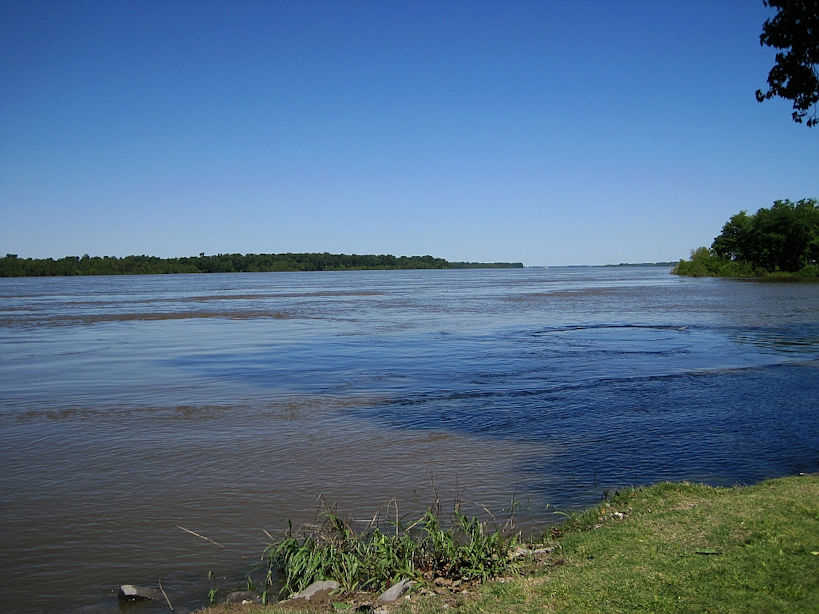
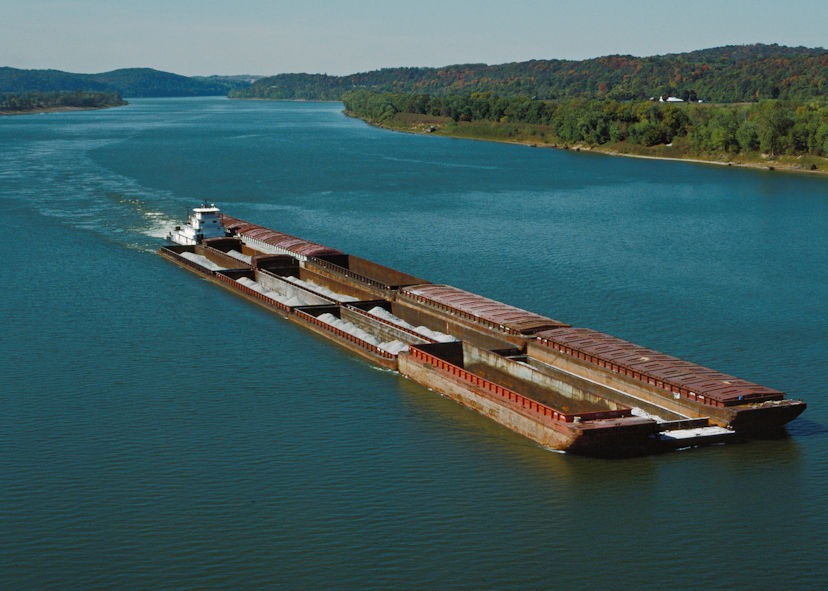
I learned about Mark Twain and his adventures, both real and fictional, on the Mississippi River. He was born in Hannible, Missouri, (river mile 1262) north of St. Louis (river mile 1132).
Later, a professional career made everything about rivers my daily occupation. I learned what T.S. Eliot thought about this same big river. He was born in St. Louis and spoke about the Mississippi in the third of his Four Quartets.
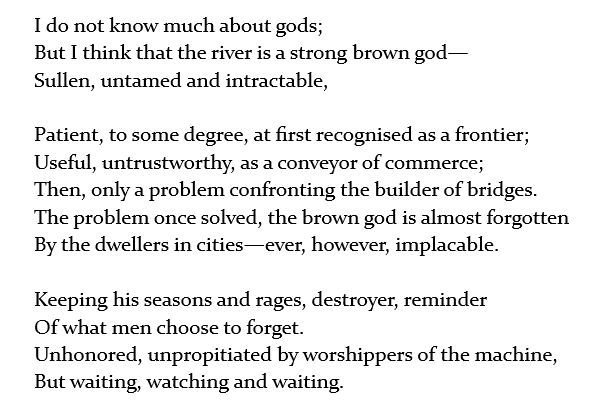
A few lines later, Eliot says,
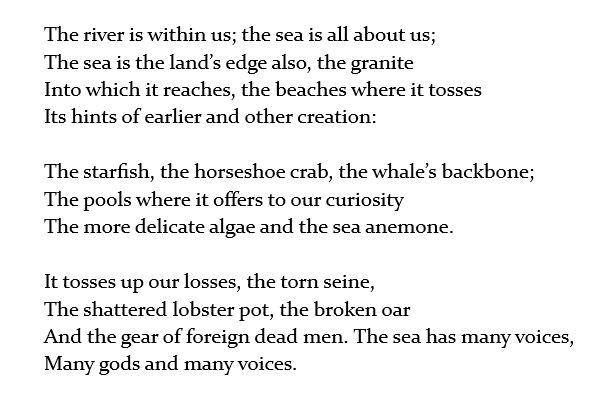
Most people don’t realize that without rivers, there would be no beaches. The streams run off the land and bring sediment to their ocean outlets. This river sediment forms delta fans on the seabed, allowing tides to sift out the sand and transport it along the coastlines by longshore currents.
Eliot may have been alluding to Greek mythology, talking about a brown river god. Homer’s Odysseus, escaping the island of Calypso on a raft later broken apart by rough seas, floated on heaving sea waves in search of a landing spot. As Robert Fitzgerald’s translation puts it, in Book 5:
The Earth’s liquid water, whether salty or fresh, with its weight and power, is something humans have always needed to be wary of. Ancient peoples knew their ships could be overturned by big waves or crash against rocky outcrops of land. Not to mention mysterious sea creatures such as Leviathan. Ancient armies could be diverted many miles in their attempts to find safe places to cross rivers. Later mapmakers could draw coastlines, but out in the oceans, they would often write: “Here be dragons!”
We river professionals know that flowing river water is overwhelmingly powerful. Humans have built massive dams to try to contain it. Incoming runoff sometimes breaches these dams, with disastrous downstream consequences. Water is heavy stuff. Flash floods in steep desert streams can move enormous boulders. These types of flow pick up so much soil that it can have the texture of pancake batter, often referred to as mud flows or debris flows. Check out this YouTube video by David Rankin. About halfway through, you’ll see the mud flow rolling a huge boulder (I’d guess about 5 feet in diameter).
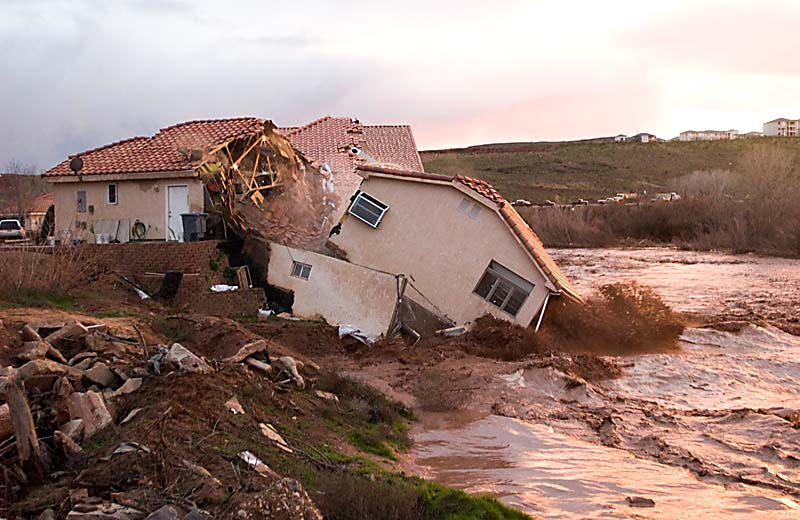
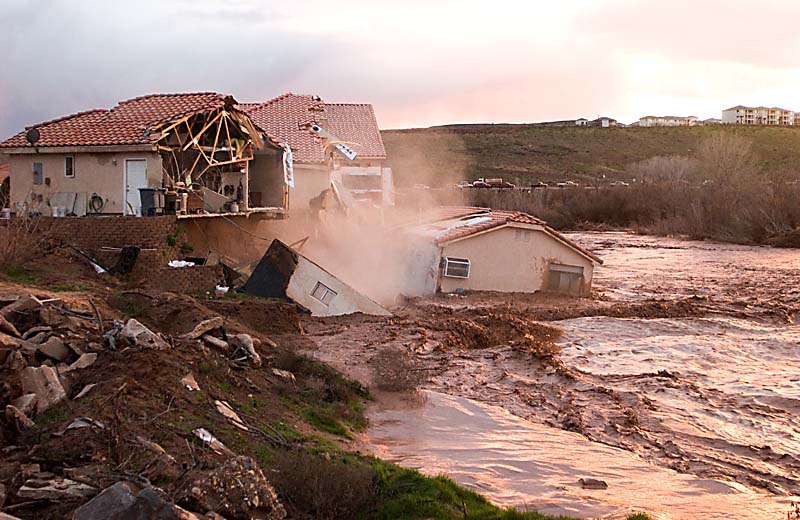
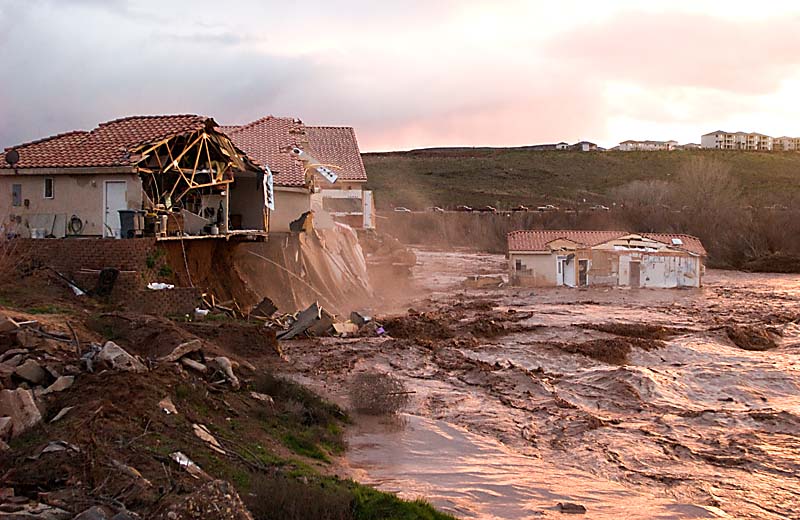
Water can be relatively free of debris and still tear things apart. A 2005 flood on the Santa Clara River in St. George, Utah, took out several homes that had been built many feet back from the riverbank. The house below was already severely undermined when a small shed came along, which gave it a final nudge.
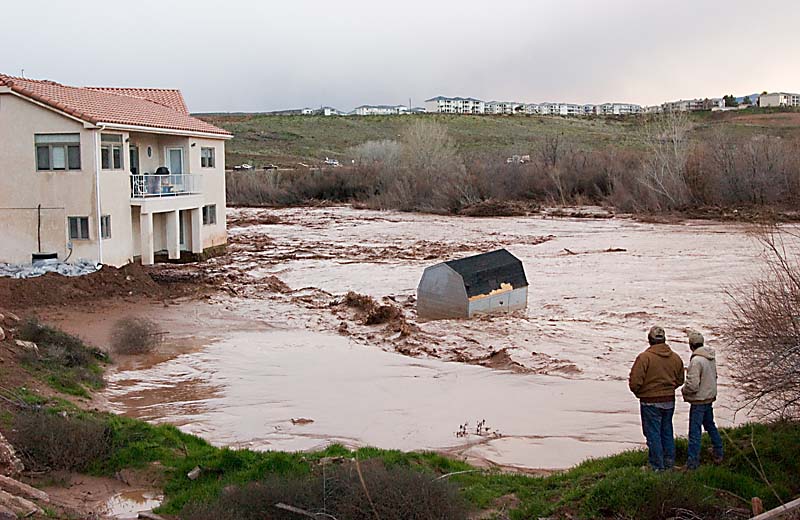
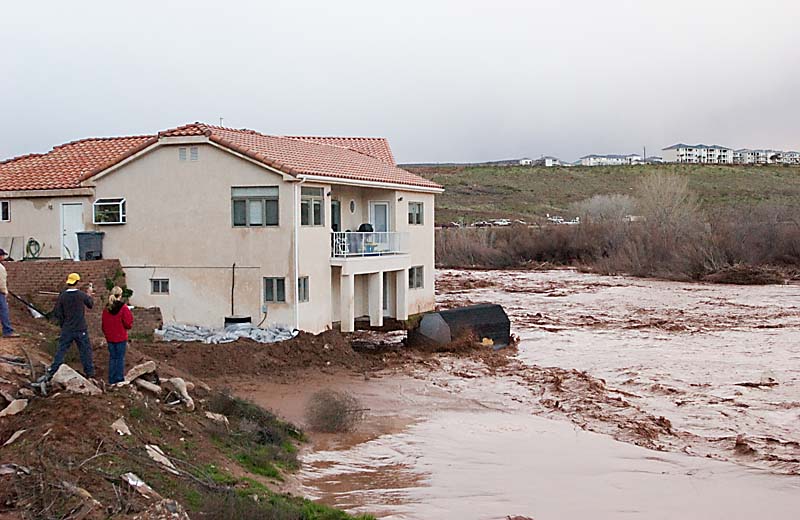
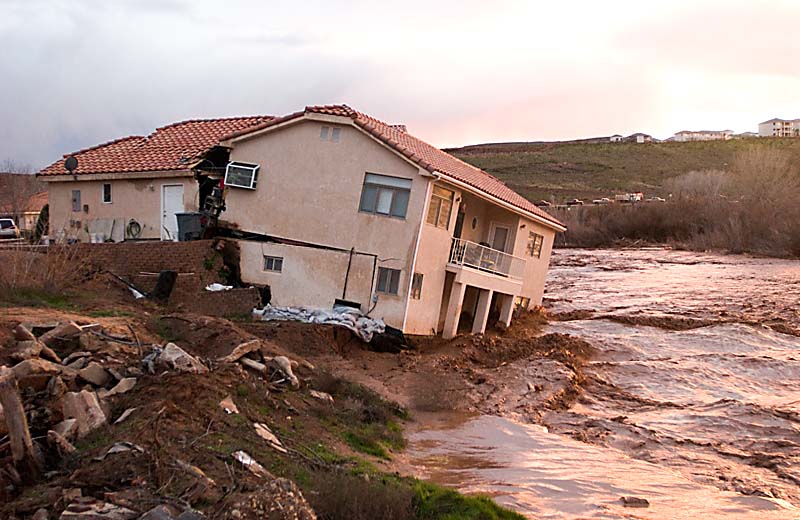
Houses in the same area are also featured in the following YouTube video, shot from the opposite bank, a total of 27 lost to the river.
St. George, Utah, houses destroyed by the Santa Clara River.
Most of us do not personally witness such destructive water forces. However, our daily lives can offer us a few clues. We have felt the weight of a gallon of milk, lifting it into the refrigerator. That’s one gallon. The average flow rate of the Mississippi River at Memphis is 593 thousand cubic feet per second. That equates to almost 4.5 million gallons passing under the I-40 bridge every second. The weight of that water? About 18.5 thousand tons (every second!).
Water is heavy! Heavy with meaning. Ancient scripture shows our reverence for rivers. They are sacred:
But let justice roll out like waters, And righteousness like an ever-flowing stream. Amos 5:24
The one who believes in Me, as the Scripture said, From his innermost being will flow rivers of living water. John 7:38
For the Lord your God is bringing you into a good land, a land of streams of water, of fountains and springs, flowing out in valleys and hills. Deut 8:7
For I will pour water on the thirsty land And streams on the dry ground; I will pour out My Spirit on your offspring, And My blessing on your descendants. Isaiah 44:3
Another spiritual metaphor is the symbolism of being baptised by full immersion in water. One is cleansed of sin, the former life is sacrificed, and one is born into a new life. John the Baptist used the placid Jordan River for his rituals. Yet, even slow rivers can make big impressions, if given time.
The Colorado River is much smaller than the Mississippi. Entering the Grand Canyon, the average flow rate of the Colorado is 3 percent of that at Memphis, quoted above. Yet, given five million years, the mighty Colorado carved the Grand Canyon.
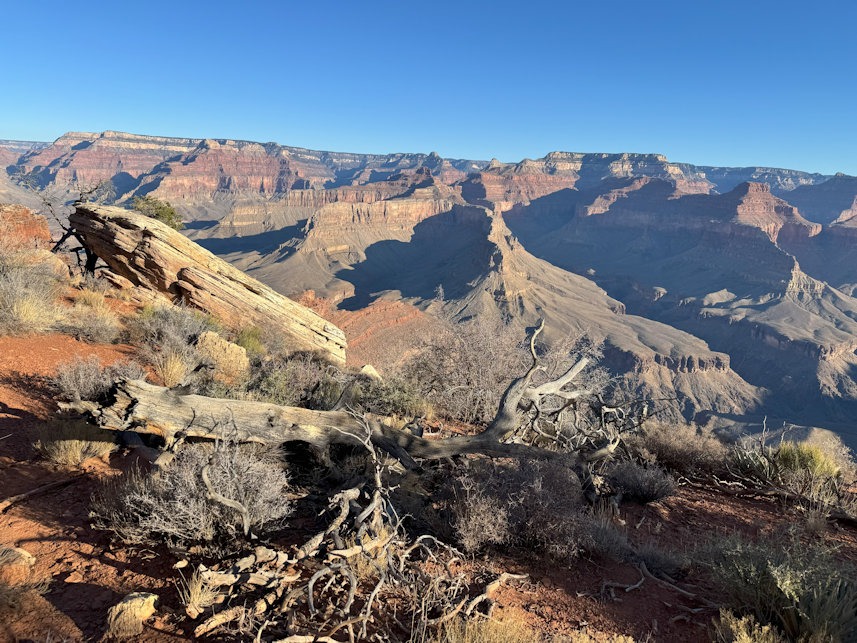
Apparently, as Eliot said, rivers can be patient. They persist in doing the biblical work of returning mountains back into plains. Our lives give us brief glimpses of their work.
To end with dad joke metaphors, when someone asks you how your life is going, why not say, “Currently, things are going swimmingly!”
fascinating footage and commentary
Great to get these thoughts from someone who really knows rivers.