This post is a meditation on what makes you you and what makes me me. Where to start?
Please excuse me while I mull. It took me just under three seconds to write that and inform my unconscious that I wanted it to gather information from previous experiences, list comparisons and contrasts, and begin to prioritize quality options. My brain proceeded to inform me that it knew what I wanted all along. Mulling is its job, after all. It wants to mull, and I actually gave it a barely conscious go-ahead before taking the trouble of speaking or writing the words. It was mulling the whole time.
My unconscious and I are a great team. In fact, we are inseparable. I guess when I say “I” this refers mainly to my conscious self. After all, I don’t know what my unconscious is doing, second by second. It runs on its own, without too much direction. Yet, we seem to have a feedback loop. I can consciously get it to change what it is mulling over.

credit: Beth Scupham on Flickr
Some neuroscience experiments have shown that our unconscious mind makes decisions milliseconds before we know it, and we immediately deceive ourselves into thinking we made the conscious decision. But this characterization depends on our common tendency to think we are separate from our brains and bodies. The distinction can be helpful, but it can also mislead. If I decided something subconsciously, does that mean somebody other than myself decided? Doesn’t my brain know me better than what I have consciously learned about myself or my brain? If you want to say I am not fully who I think I am, I would agree, except to add that here it would be better to accept the unity of brain, body, and consciousness, and that I probably know a lot subconsciously. Not everything needs to be brought into the mental language area of the brain. “Who is in control?” is a stupid question. I am happy that I don’t have to keep telling my heart to beat or my gut to digest. And I am really happy that my brain can mull without my constant direction. I can sleep on it or bask in the sun. I can go for a run or chop wood.
What about spirit? What I have described above would seem similar to using artificial intelligence. In that case, I am not aware of the data gathering, sorting, and language processing being done by AI. It presents me with information, and I proceed to think about it. Ironically, as soon as I read what AI has come up with, my subconscious gets to work mulling, while I simultaneously speak words to myself about the issue.
So, what about spirit? I am a Jesus follower and think the concept of spirit is helpful. But I am probably also a radical Christian because I do not think my spirit or soul is something physical that resides inside me. Nor do I consider my spirit to be a ghostly version of myself or a part of the ghostly Holy Spirit (which I also don’t think is ghostly, takes up space, or moves around). I think of spirit as part of me, the same me that includes mind, brain, and body, all integrated. But spirit does function in a very important additional way. It takes into account possible interactions with the Creator, with other people, with animals, and with all the other created things. To follow The Way is to align with the reality of the Creator. If the Creator is life-affirming, then my mind-body-spirit can sense the value of aligning with, agreeing, and acting out life affirmation. Over time, I learn what affirming life means and how the Creator values all people, not just certain ones, and all of creation, not just people. So my spirit is a way that my mind and body gain a measure of unification with the Creator, other people, animals, and things.
One can make a distinction between good and bad spirits. To align with the Creator is good. To attempt swimming against the current of reality is unhelpful and can be called evil. If the Creator is life-affirming and you continually seek to quash the lives of others, you endanger yourself. Your spirit can be called evil if you join a like-minded community and together get personal support for non-life-affirming thoughts or actions. No matter whether you “get caught” or not, to be mistaken about reality will bite you eventually.
Readers of Mind in Heart may remember where the blog name comes from. A seventeenth-century Eastern Orthodox monk named Theophan the Recluse was once asked to define prayer. He replied,
The principal thing is to stand before God with the mind in the heart and to go on standing before him unceasingly day and night until the end of life.
To see it that way does not seem to make prayer any easier. Do I really need to be some way unceasingly? Yet, maybe it does free us a bit. Theophan says that your state of mind is more important than speaking words. And having your mind constrained by your heart is more important than stopping, sitting down, closing eyes, and folding hands. It reminds us of what Jesus said about insides being more important than appearances. If your façade hides too much of the real you, then deceiving others fosters deception of yourself, and life affirmation is thwarted. Your spirit is inherently part of a community of spirits, which includes the Spirit of the Creator. To pretend is the definition of hypocrisy. The etymology from the Greek “hypokrites” is to be an actor, to present a false front. The gospels show in story after story that Jesus did not like hypocrisy. To be a Christian, I must be real with others so that we have a chance to develop community and good spirits.
So, what makes us who we are? One thing seems clear. We are not a homunculus. We don’t have a tiny person inside of us who runs us without our realizing it. This little person would direct us what to think and do, and we would go on to obey it, all the while thinking it was us making the decisions. This funny idea has ancient roots, but is also a concept in modern neuroscience.
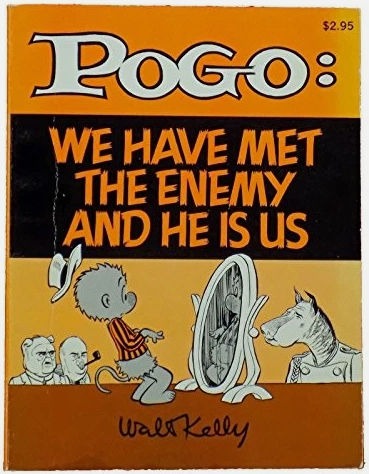
I am reminded of the great quote from Walt Kelly’s Pogo, riffing on Napoleon:
We have met the enemy, and he is us.
As a spiritual person, I can’t help laughing at how science can maybe get off track because it wants purely natural explanations and therefore cannot accommodate the idea of human-Creator interactions.
We are more marvelous than having a little person running us like the Wizard of Oz! Doesn’t it seem that David may have gotten closer in Psalm 139 when he declared:
You have searched me, Lord, and you know me.
Before a word is on my tongue, you, Lord, know it completely.
Such knowledge is too wonderful for me; too lofty for me to attain.
I praise you because I am fearfully and wonderfully made.
Search me, O God, and know my heart; test me and know my anxious thoughts.
See if there be any offensive way in me and lead me in the way everlasting.
I hope you find encouragement in this meditation. Here at the end, I am reminded of a song by Cat Stevens. Yes, way back to the sixties and seventies, the olden days of my youth. From his album Mona Bone Jakon (don’t look up the meaning), he wrote I Wish, I Wish, which was also featured in the cult classic movie, Harold and Maude. (Lyrics below, or listen on YouTube.)
I wish I knew, I wish I knew
What makes me, me, what makes you, you
It’s just another point of view, oooh
A state of mind I’m going through, yeah
So what I see is never true, ahhh
I wish I could tell, I wish I could tell
What makes a heaven, what makes a hell
And do I get to ring my bell, oooh
Or land up in some dusty cell, nooo
While others reach the big hotel? yeah
I wish I had, I wish I had
The secret of good, and the secret of bad
Why does this question drive me mad? ahhh
‘Cause I was taught when but a lad, yeah
That bad was good and good was bad, ahhh
I wish I knew the mystery of
That thing called hate, and that thing called love
What makes the in-between so rough? ahhh
Why is it always push and shove? ahhh
I guess I just don’t know enough, yeah
If only Cat Stevens would join Mind in Heart and come to this meditation. Of course, he was very young when he wrote I Wish, I Wish. He has probably gained the wisdom to agree with what we say here.