Many Mind in Heart readers will have heard of the Inklings, a mid-20th-century group of British writers and thinkers who enjoyed discussing literature and the art of fiction. Their most famous members were J.R.R. Tolkien and C.S. Lewis. The group name seems to have been whimsical: they were dabblers in ink, writers with mere inklings of words worth saying, considering each other’s Rorschach inkblot writing samples and giving first impressions. They seem to have enjoyed reading aloud to each other and bantering about meaning and aesthetics.
Brits cogitating (only meant to similarly portray the Inklings). Credit: p. 588, Busyman’s Magazine, July-December 1906
Although fiction served as the Inklings’ raison d’etre, they may have agreed that poetry provides the ultimate medium for creative interpretation and elegance. The poetic art form has some rules, but these are routinely bent or broken, as are many boundaries of normal prose, both grammar and word definitions. With poetry, we sense additional meaning through rhythm, and much of it is best experienced by recitation.
Another of the Inklings wrote a book entitled Poetic Diction: A Study in Meaning. The author, Owen Barfield, was said to have influenced both Tolkien and Lewis.
A recent New York Times article discussed the art of poetry. A.O. Scott presents a famous short poem by Ezra Pound, well known to the Inklings, in a piece entitled These 20 Words Are Worth a Thousand Pictures, to wit:
IN A STATION OF THE METRO by Ezra Pound
The apparition of these faces in the crowd;
Petals on a wet, black bough.
Scott imagines Pound sitting on a shadowy Paris train platform, circa 1911, observing the hubbub of moving passengers, and writes, “The poet finds an echo of serene natural beauty in a hectic modern scene.”
Scott then asks the reader to consider whether this is a legitimate poem. What makes some writing a poem? I find his answer exquisite:
Trying to answer that question helps us understand not only how poetry works, but also how our sense of language commingles with our other senses to infuse our simplest experiences with a kind of magic.
I encourage you to read the entire article. For me, it was a nice break in the Times from incessant news about war, political intrigue, crazy weather events, tariff games and other Trump flimflam.
No doubt poetry can have this magical power to break some rules and bend some meanings, to give it a beat and sometimes rhyme. I like many poems, but as with music we each have our own tastes. Plenty of poetry doesn’t do anything for me. (Yet, I agree that we benefit by having some idea of how poetry works.)
Scott’s statement that our simplest experiences are (in poetry) infused with a kind of magic might help us recognize that ordinary talk shares some of that magic for the very reason Scott said: our sense of language commingles with our other senses.
Turning back to fiction, consider the musings of contemporary American novelist and screenwriter, Michael Cunningham, who wrote the introduction to an English edition of the 1912 Thomas Mann short novel Death in Venice. (The 2004 translation was by Michael Henry Heim, a UCLA professor of Slavic Languages and Literature, and “one of the finest and most prolific translators of his age.”) Cunningham commented:
All novels are translations, even in their original languages. This has been revealed to me over time, as I’ve worked with the various dedicated (and inevitably underpaid) people who have agreed to translate my own books. I couldn’t help noticing that many of the problems that vexed them—questions of nuance, resonance, and tone, as well as the rhythms of the sentences themselves—were familiar to me. I’d worried over the same things when I wrote the book in the first place. It dawned on me, gradually, that I was a translator, too. I had taken the raw material of the book in question and translated it into language.
Every writer, of course, works differently, but I suspect that most novels begin in their writers’ minds as confusions of images, impulses, scattered meanings, devotions, grudges, fixations, and some vague sort of plot, to name just a few. A novel in its earliest form, before it begins to be rendered into language, is a cloud of sorts that hovers over the writer’s head, a mystery born with clues to its own meanings but also at its heart, insoluble. One hopes—a novel is inevitably an expression of unreasonable hopes—that the finished book will contain not only characters and scenes but a certain larger truth, though that truth, whatever it may be, is impossible to express fully in words. It has to do with the fact that writer and reader both know, beneath the level of active consciousness, something about being alive and being mortal, and that that something, when we try to express it, inevitably eludes us. We are creatures whose innate knowledge exceeds that which can be articulated. Although language is enormously powerful, it is concrete, and so it can’t help but miniaturize, to a certain extent, that which we simply know.
Many of us, especially retired older folks, dream of writing the Great American Novel, or becoming the Robert Frost of their generation. Success in these endeavors takes a lifetime of hard work and some amount of good fortune. Yet, what Scott was pointing to above about poetry and Cunningham about fiction seems true of anybody trying to express themselves with words.
Before we might become adult poets, we learn as children to navigate the world with sounds that dawn on us to have communal meaning. To start, we hear our parents and pick up their words. Our little minds absorb ideas (mental images associated with words) not only to communicate with others but also to think for ourselves. Toddlers might be able to think without words, but they quickly realize that words offer greater power. Instinctively, we know that words help us think. Yet, we also use some words we only vaguely understand. If we care to learn, attaining proficiency is a lifelong trajectory. We have our stock of confident words and a bunch that we like but are less confident of understanding. Here, use it or lose it applies, and we can be grateful to friends and elders who correct us when we err. We might be able to look back and laugh at a word we used, mistaken about its meaning. Not to mention when we get corrected for putting the em-pha’-sis on the wrong syl-ah’-ble!
Animals think without words, but humans do something more with their language. Dogs know what you mean when you say “walk” or “treat.” But people can add an imaginary timeline. You will not help a dog by saying “we’ll go for a walk later” or “you already had a treat.”
What’s more: humans employ incessant playfulness and symbolism. We constantly say things, expecting others to grasp something other than the ordinary meaning. We find joy in applying labels that would be funny if taken literally:
Emily is blue today.
Dad is on cloud nine because his team slaughtered their opponents.
I’ll go to bat for you with the boss.
These aren’t poets. The speakers are not trying to be artistic or use flamboyant language. They find metaphors that efficiently get across what they want to say. Yet, each of the above lines will have been said without the least conscious use of metaphor.
Most human language is subconsciously metaphorical. The smooth efficiency they provide makes us focus on whether we successfully communicated rather than the literal incorrectness. Everybody “gets it.”
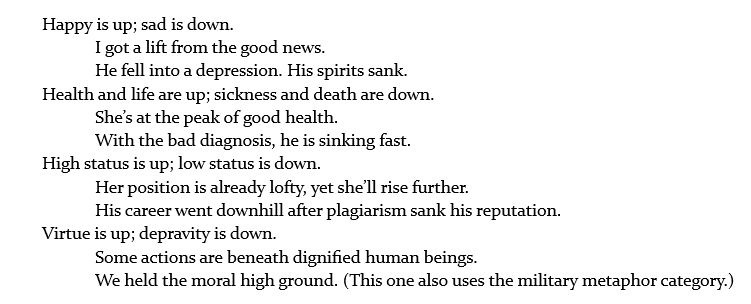
No one would respond to the report of Emily being sad by pointing out that her skin color remains the same and she is not the least bit blue. Linguists who make research projects out of carefully examining what people say see entire cultural or societal metaphors at work. To take a single category, spatial metaphors, here’s a list from Metaphors We Live By, 1980, by Lakoff and Johnson:
Many of our individual words are intrinsically metaphorical. All one needs to do is look up etymologies. Take the word metaphor itself.
Metaphor originates from two Greek words: meta “over, across” and pherein “to carry, bear.” In other words, we use the word metaphor metaphorically as we try to transfer meaning across a bridge between two people. The metaphor helps carry meaning from one mind to another through space.
Here are just a couple more inherently metaphorical English words derived from Greek:
helicopter: from helikos (spiral) and pteron (wing)
contemporary meaning: a flying machine that works by spinning wings
anticlimactic: from anti (opposite or against) and klimakter (rung on a ladder)
contemporary meaning: going down after having been up
Here are a couple of words in English usage with German roots:
kindergarten: kinder (children) and garten (garden)
contemporary meaning: pre-elementary school
doppelgänger: doppel (double) and gänger (pedestrian)
contemporary meaning: a person’s perceived double, twin, or lookalike
We don’t notice our metaphorical use of words adopted long ago into English from other languages, which no longer retain their original literal meanings.
Interpretations and Translations
No writer of fiction or poetry would try to tell you as a reader that you can only legitimately understand their output in a particular way, namely the meaning they intended. These artistic expressions inherently impact each reader uniquely, and the reader’s interpretation inextricably depends on their own experience.
But non-fiction writers must also concern themselves with whether they employed the best language to convey their points. They are not entitled to expect readers to understand them one hundred percent unerringly. After all, sometimes when they reread their own writing, they want to edit and try saying things differently. In those cases, they reinterpret their own thoughts. Ordinary conversations have similar “trial and error” iterations. We might say something and observe that our listener “doesn’t get it” or immediately think we could have said it better.
Biblical inerrancy
Thus, you may have anticipated my take on the controversy among many Christians about whether:
- the Bible is the inspired word of God,
- the various writers wrote as if God was moving their hands, and
- the sentences in scripture have only one correct interpretation (the most literal one)
The idea that the Bible is inerrant becomes almost funny. The words cannot err, only our understanding of them.
Those who claim inerrancy always have a particular interpretation in mind, and one that some respected pastor or scholar has suggested. They are close-minded about other ways to understand the Bible because they long for the safety of certainty.
They also tend to forget that the original Greek or Hebrew may have gone through the hands of many ancient scribes. Translators of those writings into English had to face the same issues mentioned by Cunningham above. Sometimes they would have found that no English could perfectly convey the original. Over the millennia, God would have had quite a task to intervene at each of these steps. Someone might insist that our all-powerful God would have found it no trouble. But we suspect God is simply not like that. He can handle the fact that we sometimes fail to write perfectly or misunderstand what we read.
We Christians are better off seeking the Spirit’s help when we read the Bible. Instead of trying to find the one correct meaning, we should allow that the Creator may bring to our minds any number of different ideas and issues each time we read the same passages. We can offer praise that the Creator gives us freedom to be mistaken, even while he desires that we continually learn who he is. He wants his character to rub off on us.
As we revel in the idea that we have been made in the image of the Creator, we are set free from the need to be certain about the meaning of every Bible passage. Let’s look back to that member of the Inklings most revered by today’s evangelical Christian community, C.S. Lewis.
An internet search of Lewis and the subject of Biblical inerrancy reveals numerous articles in which evangelicals praise Lewis for his apologetics, but make excuses for his, in their judgment, mistaken idea that the Bible could have errors or might not ought to be taken literally in every book.
One article, for example, defends the “mere Christianity” of Lewis as a bare minimum set of beliefs for a person to be a Christian, while contesting other opinions of Lewis that many of today’s evangelicals dispute.
According to Beyond Mere Christianity: An Assessment of C.S. Lewis, by Steven P. Mueller, the “mere Christianity” of Lewis was like a common hallway from which many doors could be used to enter any of the many denominations. Of course, these doorways could be ranked for quality of the additional beliefs to which they lead, with some perhaps veering into utterly mistaken ideas.
Mueller considers Lewis’s doubts about Biblical inerrancy as one of his flaws and goes on to contend that one can appreciate his apologetics, but dispute his ideas that went beyond “the mere.” Citing a personal letter Lewis sent to a friend, he contends that Lewis found reason to doubt Biblical inerrancy because of inconsistencies, especially in the gospels, but also in what he considered obviously mythical stories such as Job and Genesis. In that letter, Lewis wrote:
The total result is not “the Word of God” in the sense that every passage, in itself, gives impeccable science or history. It carries the Word of God, and we (under grace, with attention to tradition and to interpreters wiser than ourselves and with the use of such intelligence and learning as we may have) receive that word from it not by using it as an encyclopedia or an encyclical but by steeping ourselves in its tone and temper and so learning its overall message.
I’m with Lewis on that, and believe our ability to understand scripture is enhanced when we desire input from the Spirit of the Creator and come to it knowing that love is a life force of the Universe.
As we at Mind in Heart believe in affirming people’s lives, we should use the same strategy when we converse with others and try to understand them. We listen patiently to anyone trying to find words to describe what they feel or think.
Here’s a bit of poetry, a snippet from a Bruce Cockburn song. With the word “light,” think of starlight as a metaphor for the Spirit and how it can affirm us and build us up:
Look How Far (click to catch the beat on YouTube)
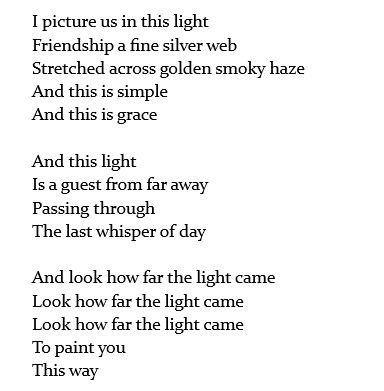
I believe that the Spirit inspired the Bible writings and that the writers did their best, but may not have written perfectly. I also believe the Spirit inspired Cockburn’s lyrics above. (Yet, you won’t hear this song on a Christian radio station.) We can hope that words of encouragement we try to give others have also been inspired. I like the idea that being made in the image of the Creator means we can, in some ways, be co-creators with him.
Very well said, although I wish it could have been a little shorter/tighter – but I’m unsure exactly what I would cut.
Especially loved this: “All novels are translations, even in their original languages.” It succinctly and eloquently conveys its meaning. I might phrase it “All writings are translations …” or even “All utterances are translations …”
I also very much liked the C.S. Lewis quote: “steeping ourselves in its tone and temper and so learning its overall message”. Again, a succinct and eloquent way to explain the best way to approach the Bible.
My feeling is that, while it’s possible God (as an all-powerful being) directed/controlled/mechanized writers to ensure scripture’s inerrancy, this argument/explanation feels stretched thin to prove a particular viewpoint that is otherwise unsubstantiated.