author’s note: While obviously inspired by Rudyard Kipling’s Just So Stories, no artificial intelligence was employed for the writing of this tale.
Attend, concentrate, take heed, and listen, my Dear Ones, as I disclose, decipher, resolve, elucidate, and clarify how the octopus got its beak. These mushy creatures may have many features that you didn’t know about, since they live underwater and we don’t. You may know they have eight legs covered with little suction cups that help them grab onto things. They have two eyes just like all of us. Underneath, at the axis where all eight legs come together is the octopus’s mouth. But it doesn’t have lips like you and me. The mouth is a beak, just like a bird’s.
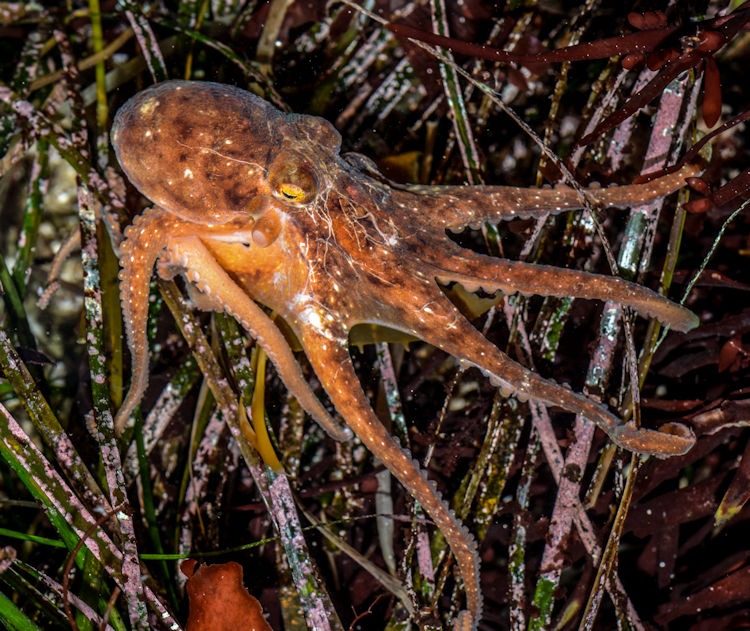
photo credit: credit: Jerry Kirkhart from Los Osos, CA. download
Now, there was a time, very, very, very, very, very long ago, when everything lived underwater.
Everything on the whole wide Earth lived underwater because water was everywhere, and what land there was was only holey lava rock. Burger Kings had not yet evolved. There were no teenagers or any people at all. There were no monkeys, no elephants, no horses, no dogs, and no cats. No snakes slithered in the grass because there was no grass anywhere. No birds flew in the air. This was so long ago that even dinosaurs had not yet evolved.
But the seas had life—just not the plant and animal life we know of today. The first life that decided to live in the Ocean was so small that if we had been there, we couldn’t have seen it. Life was able to grow bigger because of two energy sources: the Sun, bringing warmth from the sky, and underwater thermal vents, bringing warmth to the ocean floor from the middle of the Earth.
Millions of years went by, but nobody got bored because nobody was there. I only know about this myself because a very wise little bird told me. This was a Budgie named Zerubbabel, whose name we will shorten to Zubie. So Zubie’s a Budgie. Did you know, my Dear Ones, that there were birds called Budgies? Neither did I! But wouldn’t it be fun to have a Budgie buddy? And I must further explain, because you should know, Dear Ones, that a Budgie is a kind of parrot.
Anyway, Zubie could talk, but he was shy with most people. He belonged to friends of mine who liked to go on vacation a lot and needed someone to look after their bird. I got to know Zubie very well because I babysat him. Or, wait—I parrot-sat him. But I didn’t sit on him; that would be unkind.
Zubie got to like me a lot and trust me. I think he especially appreciated that I honored his intelligence. I wanted to know what he thought and asked him about all kinds of things. At first, I didn’t expect too much in the way of a verbal response. I thought he might say, “Hello!” or “Whatcha doin’?” But after being with him many times, Zubie started to confide in me.
He said, “Don’t tell Bill and Sue, but I can say more than the silly things they think they have taught me.”
I promised not to tell. We conversed. We didn’t just talk, my Dear Ones; we conferred, deliberated, discussed, brainstormed, and otherwise hobnobbed. Eventually, I realized that Zubie might know many things that I did not, especially about what happened thousands of years before we were born.
You see, Zubie told me that Budgies pass down wisdom from generation to generation by word of mouth—I mean, word of beak. They know things that happened a long, long, long, long, long time ago.
I asked him if he knew how Budgies evolved. He said, “Don’t you know that birds used to be dinosaurs?” I said I had heard that, and he declared it was so. Basically, he said it came down to trying different options. Being big didn’t work very well, so they thought they’d try going for the small end.
When I said that scientists think everything used to live in the Ocean, Zubie agreed and said it was so. He said there was a lot of back and forth in the early days. Zubie said, according to Budgie lore, the first land animals lived both in the water and on the shore. And this was long after meteors had stopped bashing into the earth and making enormous potholes. Plants were growing on the land and creating soil for many more plants to grow. But Zubie said sometimes, after years of living just on the land, an animal would decide it wanted to go back to the water.
“If you think birds are weird dinosaurs, let me tell you something,” Zubie said one time. I waited for him to continue.
“Well,” he said. “You know there are many kinds of parrots, and some are a lot bigger than Budgies.”
“Yes,” I said. “And some are quite talkative.”
Zubie continued. “And some are not very smart. Don’t get the idea that bigger parrots are smarter parrots.”
“I won’t!” I assured him.
“There was a time, in the early days of parrots, that one of them decided that trees were boring. This was a fairly stupid parrot, but it was at least smart enough not to walk around on the ground, where it could be caught and eaten by any number of different four-leggeds. He decided to go back to the water.”
“Can parrots swim?” I asked.
Zubie said most parrots don’t go into the water, but if they did, they would not need to swim. “You couldn’t sink a parrot if you tried!” he said. “They are incorrigible floaters!”
So, it seemed that this oddball parrot would not succeed if he tried to return to the Ocean. Zubie said that Budgie legend had it that the parrot’s name was Aloysius, but everybody called him Hoppy. Have you ever tried to get a parrot to say “ah-lo-wish’-us,” O my Dear Ones? They called him Hoppy because, in his boredom, he would hop around the tree branches more than any other parrot.
Zubie said Hoppy went to the beach. He succeeded in returning to the Ocean, but not the way anyone would have expected. He saw some pelicans floating around near shore and flew over to join them. Zubie figured Hoppy wanted to ask them how to get along in the Ocean environment, catching fish and all.
Turns out pelicans do not speak parrot. Hoppy was surrounded by something like a dozen pelicans, and not one of them could understand a thing he said. They just ignored him. But all of a sudden, the whole crew got jumpy and started flapping their enormous wings to lift themselves out of the water, and they flew off.
Hoppy could not have done that if he tried. Nor had he seen the nearby water bulging with a dorsal fin breaking the surface. An orca was coming straight at him.
You may be thinking, O Dear Ones, that killer whales don’t eat birds, and they usually don’t. But this one was curious about a funny, colorful bird he had never seen before and figured he’d check him out. (The way a whale checks something out is to swallow it.) As he swam straight at Hoppy, the orca, whose name was Augustus, expected the creature to fly away, but it just sat there. So suddenly Augustus swallowed Hoppy whole.
I need to tell you something else about orcas, my Dear Ones. Other whales, like humpbacks or blues or grays or right whales or fin whales, have no teeth, but orcas have lots of teeth that can grow longer than your fingers!
So, when Augustus swallowed Hoppy, the whale teeth scraped off most of his feathers, and the orca felt horribly mealy-mouthed. Whatever he had just swallowed, it was not edible to an orca. Augustus first tried to spit out all those feathers, which took some time and a lot of rinsing with seawater. Then, he tried to spit out the parrot, but Hoppy was already way down in the whale’s dark, damp inside cupboards. So, Augustus called down his throat, “Come out of there, you strange creature that doesn’t belong on the Ocean!”
Hoppy floundered with his wings stripped to bony fingers, and cried out, “I can’t see!”
Augustus decided to flap his tail fluke so hard that he could leap all the way out of the water and turn back nose-first to the surface. Maybe gravity would help dislodge Hoppy, who had never been in such a dark, goopy upside-down place. Gravity had no effect, but Augustus began to feel his stomach muscles go into action. Diving straight down underwater, he finally vomited Hoppy.
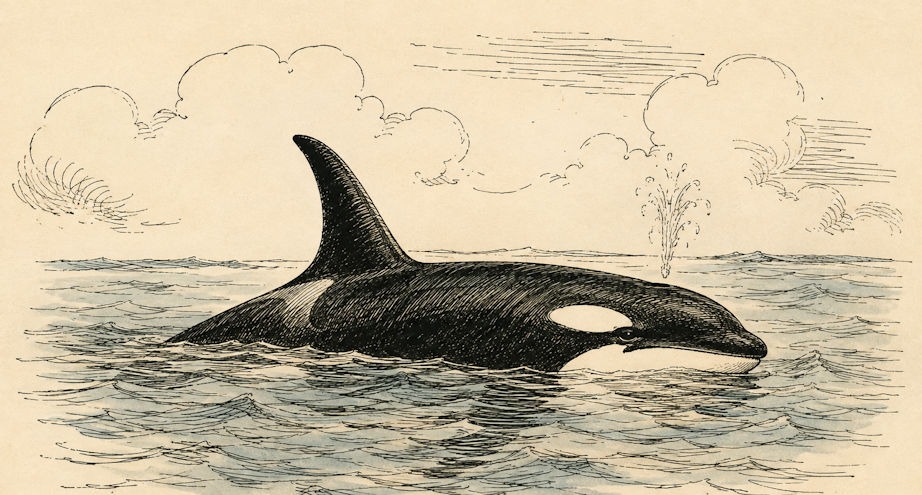
credit: Admittedly, ChatGPT, upon the command, “Draw an orca on the ocean surface in the style of Rudyard Kipling in the Just So Stories.”
But a kind of transformation had occurred. On his way out of Augustus, far beneath the surface, Hoppy felt the orca’s teeth drag him inside out. His little feet were now inside of him. His beak was on his underside. His head was covered with the bare inside of his skin, and his eyes popped around and looked through the skin from the inside.
More than one amazing thing happened. The short downy feathers around Hoppy’s beak, now on the inside of his skin, formed gills that could filter air for breathing out of the water. And the four skinny bones of his former wings now served as eight spindly legs that would help Hoppy move around in his new underwater world.
He tried to speak, but only bubbles came out. He didn’t know which way was up or down, but soon felt himself next to what we call a coral reef. Hoppy grabbed the coral surface with his eight legs and tried to orient himself.
It happened that, swimming nearby and having witnessed the entire episode was a shoal of squid. You may know, my Dear Ones, that the various animals have different group names. Fish swim in schools and wolves roam in packs. Dolphins swim in pods, geese honk in a gaggle, and bees buzz in swarms.
We don’t know who made up all these names, but we might as well use them! You now know that a group of squids is called a shoal.
This shoal of squids thought Hoppy looked just fine in his new outfit. They surrounded him to protect him from large predatory fish and sharks. They showed Hoppy how to find hiding places in the coral and how to use his eight legs to capture small fish and bring the food to his beak underneath.
According to Zubie, Hoppy did not instantly turn into an octopus. That evolution took many years. He learned a lot from the squids and got close enough to some of them that together they produced what another bird today, the stork, is known for. Over the years, Hoppy’s children attained a few squidlike features, such as fleshy suction cup tentacles around the eight legs and the ability to squirt black ink into the water to screen themselves from predators.
Since the squid had evolved for centuries in the Ocean, they contributed many advantageous attributes to Hoppy’s progeny. A feature that Hoppy contributed was color. His once-vibrant plumage was gone, but the ability to produce color remained in his genes. Thus, with squids being able to change their skin color to match whatever background they wished and camouflage themselves, Hoppy provided a new, larger palette of options.
Zubie also said he had to admit another evolutionary advantage that Hoppy provided. Remember, Zubie thought Hoppy was a relatively stupid parrot. But he was much smarter than the average squid. So, with time, the octopus became a very smart underwater creature.
I only have one more thing to relate, O my Dear Ones. Do you think Hoppy should have been called Hoppy when he adopted his new wet world? Of course, he didn’t call himself Hoppy because he couldn’t talk, with all that water everywhere. And certainly he could no longer hop. The squids didn’t talk either. But he decided to return to thinking of himself by the name his mother gave him: Aloysius.
O my Dear Ones, can you say “ah-lo-wish’-us!”?
Pretty funny. Are you going to tell us how the Burger King got its burger?
No little birds have given me an idea of how Burger Kings evolved, but I suspect it says something about the progress of human evolution.