Last week was Holy Week, and this, I just learned, is called Easter Week. Boy, did the disciples of Jesus learn something in those days! They didn’t learn everything, that’s for sure, because we humans can never learn everything. We constantly make the mistake of thinking we’ve got the entire picture. In our self-satisfaction, we go on to take actions with insufficient concern about whether we really know what we are doing.
Even Jesus wasn’t certain on Good Friday. He knew his entire ministry was headed toward his death, and he had already told the disciples it would happen. They didn’t get it. Why would the promised messiah allow himself to be murdered by the Romans? It was confusing, and they were also worried about their own skins. Jesus had warned Peter that he would deny knowing him three times before the next morning, and Peter could not help himself. After disowning Jesus twice, in the mental anguish of his uncertainty, he went on to add the third time.
When Jesus prayed that final night in the Garden of Gethsemane, he hoped God would spare him from the horrible ending. If any other way would serve, he hoped the mercy of his father would let him take it. Perhaps, he remembered how God had provided a lamb for Abraham at the last minute when he had been asked to sacrifice his only son, Isaac.
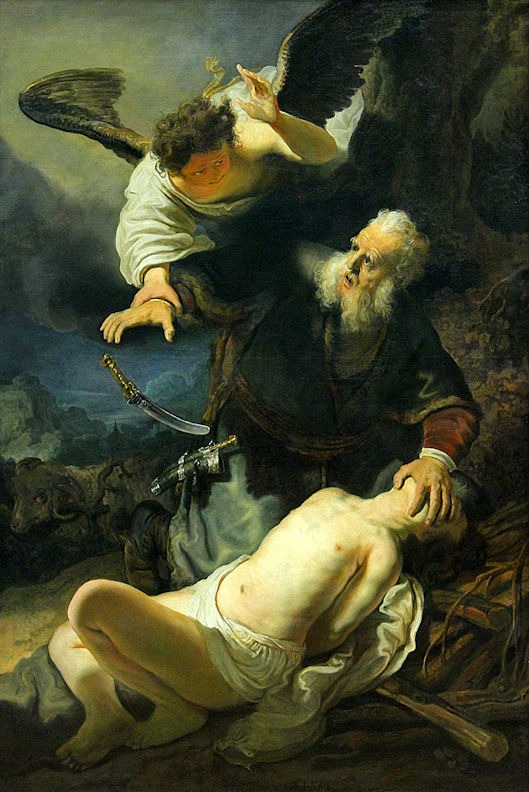
attribution: 1635 Rembrandt painting, The Sacrifice of Isaac.
Jesus was uncertain. Being the messiah did not mean he understood everything. Jesus was human. His godliness enabled him to understand more than any other human could, not to mention perform miracles, but his humanness prevented him from absolute certainty about everything. God required Jesus to proceed by faith, that is, by trusting that the Father knew what he was doing.
The eleven remaining disciples may not have even known where the body of Jesus was taken. They were in hiding, trying to figure out what to do next, and not get crucified themselves. The women, Mary Magdalene and Mary, the mother of Jesus, knew about the tomb where the body was laid.
On the third day, the two women were given first glimpse of what Easter Week was going to mean. Many encounters with the risen Jesus followed. Yet, God was pleased to leave plenty of room for skepticism. Today, if you want to believe that Jesus rose from the dead, you have to take the scriptures on faith. If you feel good about rejecting the whole thing, that has reasonable support.
But all this, the meditation on that first Easter Week, is to point out how little we have learned. We’ve had almost 2000 Easter Weeks since. But most Christians don’t trust God any more than Peter did. Both Peter and Judas thought they understood a lot. Peter was a man of action, and on the mountain of the transfiguration (in, say, Mark 9), he had the great idea of making three shelters for the transcendent beings. The scripture reports that God had mercy on Peter and instructed him nicely. Not the paraphrase I am tempted to: “Shut up and listen to Jesus!”
Judas put a lot of trust in his own intellect. He had a mental image of what God meant by sending a messiah, and it had more to do with establishing a kingdom immediately on Earth, with Jesus as King and Rome vanquished. He may have been like some of today’s Christians who think they can force God’s hand: “The second coming will happen when all hell breaks loose, so let’s encourage all hell to break loose!” Judas may have thought that betraying Jesus would force Jesus to reveal the full extent of his power. If Jesus is the son of God, then of course he cannot be killed. But if he is killed, then he must not have been the authentic messiah.
Aren’t we just so smart?
From the beginning of the scriptures, we humans are shown to be susceptible to believing lies. But it comes from trying to use our limited minds to understand what is going on. Part of our problem is being unable to sit well with uncertainty. Of course, we take account of evidence. Of course, we know that with most things, we cannot be one hundred percent certain. But we are incorrigible gamblers. We like to decide on a stance and go with it, as if it must be true. Gambling is fun! We hope we are correct (win the bet)!
Other scriptures in that same Bible may not help us overcome this unfortunate tendency. Luther was said to dislike the book of James because it put too much emphasis on good works of service as opposed to faith. I have another issue with James. In his first chapter, he teaches that we simply must ask God for wisdom and not doubt when we think we have received his reply. Don’t be double-minded! If I could talk to James, I would ask him how we can be certain that we have heard from God and are not simply believing what occurs to our own intellect. What if God prefers that we trust him with most things and not try to take them into our own hands? We humans have such a hard time sitting on our hands!
I’ve suggested previously that deception was the true original sin, and Genesis tells us that Satan set us up to be kicked out of the Garden of Eden. We got bit by believing lies, but we also learned how to use lies to our own advantage.

attribution: William Blake, 1800, Eve Tempted by the Serpent.
The worst part, which goes back to the beginning, is not recognizing when we lie to ourselves. This is equivalent to gambling that we know things with sufficient certainty.
This Easter Week, 2026, we can cry for mercy from the Creator, as we find ourselves under a constant barrage of lies. To my astonishment, some Christians dispute the idea that our current President has a habit of lying. To make matters worse, they think God has especially anointed him for this era, and therefore, he can do no wrong. They are apparently gambling on it. I am tempted to suggest that he is the anti-Christ. Yet, no, that can’t be, because it would be too obvious. He is a mere type of anti-Christ, not THE anti-Christ. Yet, his ability to deceive Christians is astonishing. Satan is the father of lies, but this man could be called “the toddler of lies.”
Some, in their certainty, figure they are entitled to emulate Jesus by declaring, “Get behind me, Satan!” to those whose beliefs differ even slightly from their own. Jesus said this to Peter, the Rock upon whom he would found his church. We can believe that Jesus knew what he was doing: instructing Peter more than confronting demon possession. We cannot even be sure that Jesus believed Satan to actually exist, rather than serve as a metaphor for human self-deception. But while Jesus knew what he was talking about, we can never know enough to tell someone the equivalent. “I know God, and you do not!”
This Easter Week, we lament that some Christians pray for God to kill other Christians. And that we have a Secretary of Defense (oops, War) who thinks God wants Iran destroyed because they are Muslims (among other things). These are two examples of people thinking they know what God wants, with disastrous consequences. I would not put it past them that their secondary wish is for God to say “enough is enough” and send Jesus back to us. Yet, God may let things play out until the modern equivalent of thirty pieces of silver is revealed, or self-destruction is applied after the discovery of being tragically wrong.