No one has accused me of being out of touch with real life or being unable to imagine what truly downtrodden and suffering people must endure. But the accusation could be justified. Mine has been a cushy life. Not that I inherited wealth or was born with any amazing gifts. But white privilege has not hurt me. Still, I’d like to believe I had a role by putting myself in a position to be lucky.
If I have never been out of a job or had trouble providing for a family, am I unqualified to think I might know what it would be like? If I never had to fight in a war and hear the thud of my buddy next to me getting his head shot off, am I unqualified to imagine what that could be like? If I have never lain starving in a wooden bunk with skeletons of emaciated people all around me and been jeered at by guards who hate my existence, am I disqualified from concluding anything about human nature?
I could go on. For example, I was:
- Never bullied on the playground.
- Never grabbed off the street and gang-raped.
- Never had my apartment building exploded by a drone attack.
- Never had a cop shoot me because he thought I had a gun.
- Never had a person on the street shoot me because, being a black man, I am inherently threatening.
I have been lucky in so many ways:
- Never had cancer.
- Never lost a baby in childbirth.
- Never had to raise a child with severe disabilities.
- Never had a friend commit suicide.
- Never been stuck behind an iron curtain or in a ghetto.
- Never had to live in a squalid government apartment complex.
- Never been stuck in a mindless job that didn’t pay a living wage.
- Never had helicopter noise all night long because my neighborhood is supposed to be crawling with criminals.
Have I thought of all the categories?
- Never had a spouse surprise me with the demand for a divorce.
- Never had to spend years trying to find a partner because nothing ever worked out.
- Never been so old or feeble that I had to be put in a nursing home against my will.
never been traumatized
Undoubtedly, all of these things cause trauma if actually experienced rather than merely imagined. I cannot advise a person about living with trauma. I cannot imagine vividly enough to experience anything close to their trauma. We understand they cannot reason themselves out of it. Being with them might help. Listening. Loving.
Apparently, trauma is treatable, and recovery is possible. We should be thankful for those who can provide professional care to make a healing difference.
Those who have recovered may again believe the world can be a safe place. They may again believe joy is possible. Yet, these more positive points of view may only come about because people have gathered around them and shown them love, demonstrating goodness. These are times when only emotional support matters, not intellectual discussions.
I like to think that Mind in Heart would know how this works. Your thought of giving answers based on your highly developed intellect would be severely tempered by the fact that you first made the ideas go through the gauntlet of your heart.
Believing in Love
Is it only because of fortunate circumstances that I believe love is a life-affirming force? Is a loving Creator only plausible to people who haven’t experienced horrible things?
Some holocaust survivors were able to maintain faith in humanity. Just try a Google search with the words, “holocaust survivors who didn’t give up on humanity.” You will find first-hand accounts.
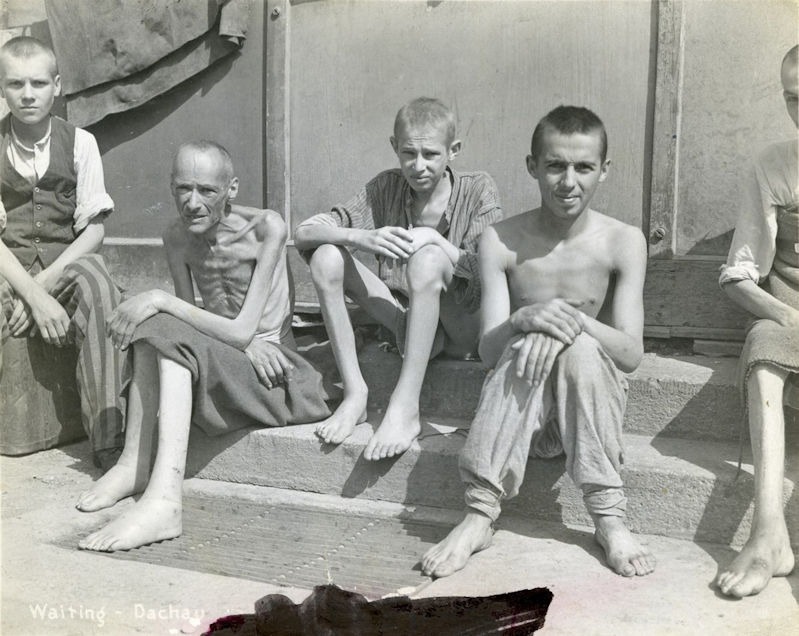
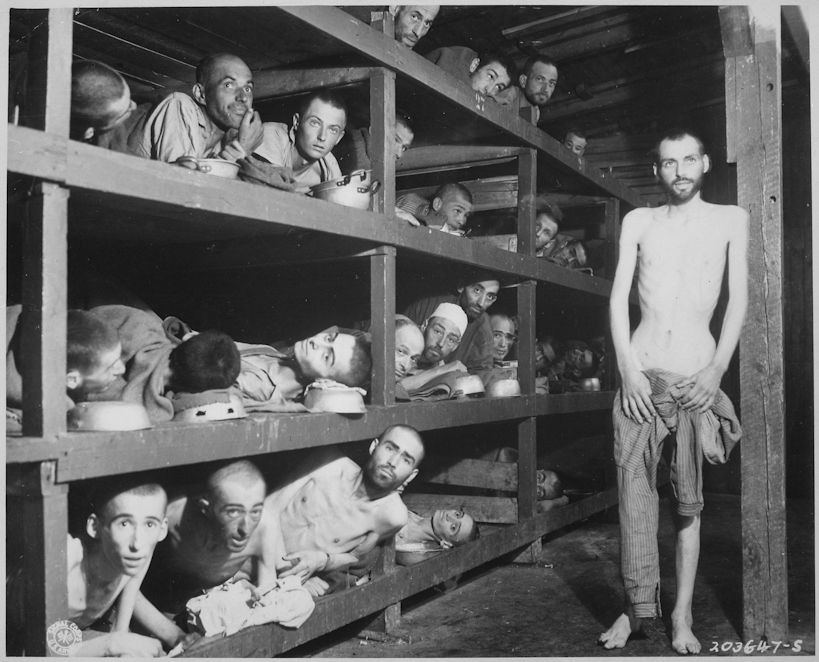
These photos accompany an article from the National World War II Museum. The left photo: Dachau concentration camp survivors outside the barracks in the newly liberated camp, 1945. Collections of The National WWII Museum. The right photo: Prisoners in barracks at the Buchenwald concentration camp. (National Archives and Records Administration, 208-AA-206K-31.)
Consider Maslow’s hierarchy of needs:
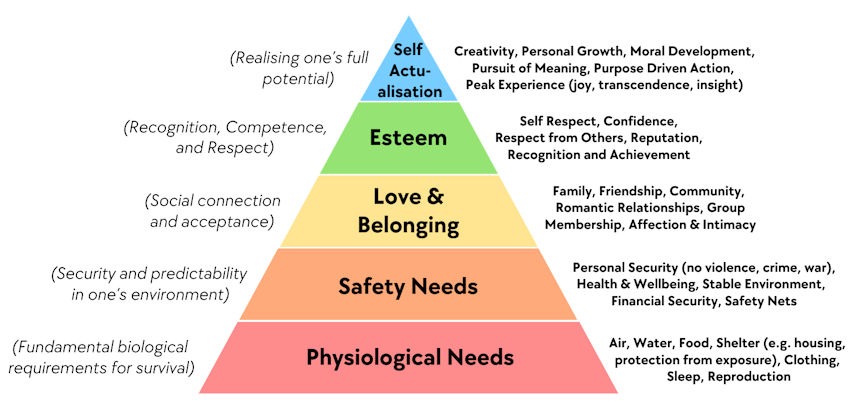
Diagram attribution: By Hamish.croker – Own work, CC BY-SA 4.0. See the Wikipedia article.
I admit to thinking I must be at the tippy top blue level. The Nazi concentration camp prisoners were on the lowest level. At the very bottom, in red, they did not even have adequate food or clothing. They were not cared for when sick or disabled. They were not free. If they did not provide some value to their captors, as enslaved workers, they were murdered. They were also murdered summarily for being Jewish. They were scapegoats.
The survivors may have risen to the second level, having had their basic human needs restored. Those holocaust survivors who did not lose faith in humanity must have risen further. To do so, they would have received love from others. Notice that the central level of the needs pyramid requires love. Everyone must receive life-affirmation or else find themselves sinking to the lower levels.
Mind in Heart is about finding ways to rise to the heights of Esteem and Self-Actualization. Being rich is not required, nor is being highly educated. More likely, a qualification to rise to the top of the hierarchy of needs would be what Steve alluded to in his comment about the River of Life post. He didn’t say where he got this idea, but I like his thought that the two sides of the river of life channel represent mindfulness/awareness on one riverbank and service to others on the opposite bank. (To read Steve’s comment, scroll to the end of the River of Life post.)
I’d add one more thing to the riverbank of mindfulness/awareness. Those two aspects seem mostly passive and receiving of environmental input. If we add curiosity, the dyad becomes a triad with an active and investigative character. The other bank, “service to others,” is already about being active, but why not hit it with both banks?
In the same way, we need the ability to imagine real-life horrors and traumatic events other people experience. First, we need the ability; then we need to care and take the time to try to walk in another’s shoes.
To be cruel to another human being or even to an animal goes against the golden rule:
Treat others as you want to be treated.
Or, as Jesus put it in his Sermon on the Mount (in Luke 6):
Do to others as you would have them do to you.
If you love those who love you, what credit is that to you? Even sinners love those who love them. And if you do good to those who are good to you, what credit is that to you? Even sinners do that. And if you lend to those from whom you expect repayment, what credit is that to you? Even sinners lend to sinners, expecting to be repaid in full. But love your enemies, do good to them, and lend to them without expecting to get anything back. Then your reward will be great, and you will be children of the Most High, because he is kind to the ungrateful and wicked. Be merciful, just as your Father is merciful.
As you can see, Jesus goes further than any normal human would. But, since I dig Jesus, I suspect he is on to something and that his extreme brand of love, his over-the-top life-affirmation, flows with the river of life. It taps into a hidden force that many spiritual people suspect exists.
In reaching the pinnacle of the needs hierarchy, one might be said to have become fully human. This is the theme of Frederick Buechner’s essay, To Be a Saint, from the book The Magnificent Defeat.
Buechner explores what it means to be fully human and cites two novels that both indicate it is related (perhaps unexpectedly) to the idea of becoming a saint: The Power and the Glory, by Graham Greene, and The Plague, by Albert Camus. A character in each novel states that the important thing in life is to become a saint.
But what does each mean? In Greene’s novel, set in revolutionary Mexico, a seedy, alcoholic Catholic priest has been caught up in violence and sits in jail with a sentence to be shot at dawn. As Buechner puts it in his essay:
On the evening of his execution, he sits in his cell with a flask of brandy to keep his courage up and thinks back over what seems to him the dingy failure of his life. “Tears poured down his face,” Greene writes. “He was not at the moment afraid of damnation—even the fear of pain was in the background. He felt only an immense disappointment because he had to go to God empty-handed, with nothing done at all. It seemed to him at that moment that it would have been quite easy to have been a saint. It would have needed a little self-restraint and a little courage. He felt like someone who has missed happiness by seconds at an appointed place. He knew now that at the end there was only one thing that counted—to be a saint.”
In The Plague, the atheist author Camus has two atheist characters talking with each other. One is a journalist and the other a doctor engaged in trying somehow to check the plague that has devastated their North African city. As Camus writes, one of them says to the other:
“It comes to this,” says one of them. “What interests me is learning to become a saint.”
Buechner uses these two literary references to lead us to a conclusion:
What is the ultimate motive that underlies the unending movement of our lives? To become men, the Latin motto says, which is to become human beings. To become saints, says this odd pair of novelists, and although their word for it is different from the other, the reality that it points to is the same. To be a saint is to be human because we were created to be human. To be a saint is to live with courage and self-restraint, as the alcoholic priest says, but it is more than that. To be a saint is to live not with the hands clenched to grasp, to strike, to hold tight to a life that is always slipping away the more tightly we hold it; but it is to live with the hands stretched out both to give and to receive with gladness.
To be a saint is to work and weep for the broken and suffering of the world, but it is also to be strangely light of heart in the knowledge that there is something greater than the world that mends and renews.
Buechner goes on to consider the question that any sympathetic reader will be asking. How can we learn to live in such a way? How can we become saints, become fully human?
[Even the good things we have] are only pearls, not ever quite the pearls the heart longs for. It is hard to know how to find it exactly. A little more courage and self-restraint, maybe. More than that. Maybe it is found best by not looking too hard for it. But this, I think, it is possible to know: that however inanely and blindly we are seeking the kingdom of heaven, and in the damnest places, literally, it is also seeking us. Because if it is our secret purpose to become saints, it is God’s unsecret purpose to make us saints. It is a “Buddha-making universe,” the Buddhist scriptures proclaim, which is to say that it is the nature of reality itself to enlighten and set free the whole creation down to the last blade of grass.
The Creator may desire that we all become fully human or self-actualized, which implies autonomy and free choice. Jesus taught that we should love our neighbors and our enemies. I define this kind of love as life-affirming. If we want to be fully human and to help others become fully human, what if they don’t want our help? We need to be able to offer without pushing and to live with rejection.
Humans seem to be experts at finding the least respectful ways to be helpful. The ability to affirm life for others is a skill to be honed. To rise above the middle level of the hierarchy of needs, we must receive love, but also learn how to truly give love. We might sometimes think what we provide is appreciated when it is not. Why would someone not want to be loved? When the love seems inauthentic or selfish. Each of us may not realize that much of our caring is conditional. Those who give us love may be able to help us see this more clearly.
To be someone engaged in active life-affirmation, we must become comfortable living on the edge of a cliff. The lazy thing is to stay back from the edge, sit on a comfortable sofa in the safety of home. The difficult situations so many people face show that many forces resist life. The higher we rise on the hierarchy of needs, the tougher the journey.